Welcome
GenAI Now and Next
22 June 2026 · 7N AI Path
Goal for this session: you will have a perspective on where GenAI is — and where it’s going.
- I will show a robust setup — not to copy, but to see how parallel work scales.
- I will answer questions as we go.
Torben Madsen · tm@kvalitor.dk
1 / 24
Welcome
Agenda
Check-in
Working with AI
Staying safe
Staying current
Q&A
2 / 24
Check-in
Five levels of AI
You can go further than you expect.
Where are you?
And how far do you want to go?
Add your answer in the live sheet:
3 / 24
Your facilitator
About me
Keypoint: I teach from the setup I use on client work — ask questions anytime.
- Consultant and trainer: what you see here is what I run on real engagements.
- Tools move faster than teams adopt them — this session is here to close that gap.
4 / 24
Pattern for everyone — not an install list
My tech stack
Keypoint: Bounded contexts unlock parallel work.
- 4–6 streams — one bounded context each.
- Reach files + tools — CLI, Copilot, or client apps.
- Map yours in the sheet — tools you use + one gap.
* cli=command line interface
5 / 24
Less friction → more throughput
The middleware is disappearing
Keypoint: Fewer handoffs — room to run more workstreams in parallel.
- Less middleware — AI creates, you check.
- AI connects to your files and approved tools.
- Steer more streams by cutting steps, not typing faster.
6 / 24
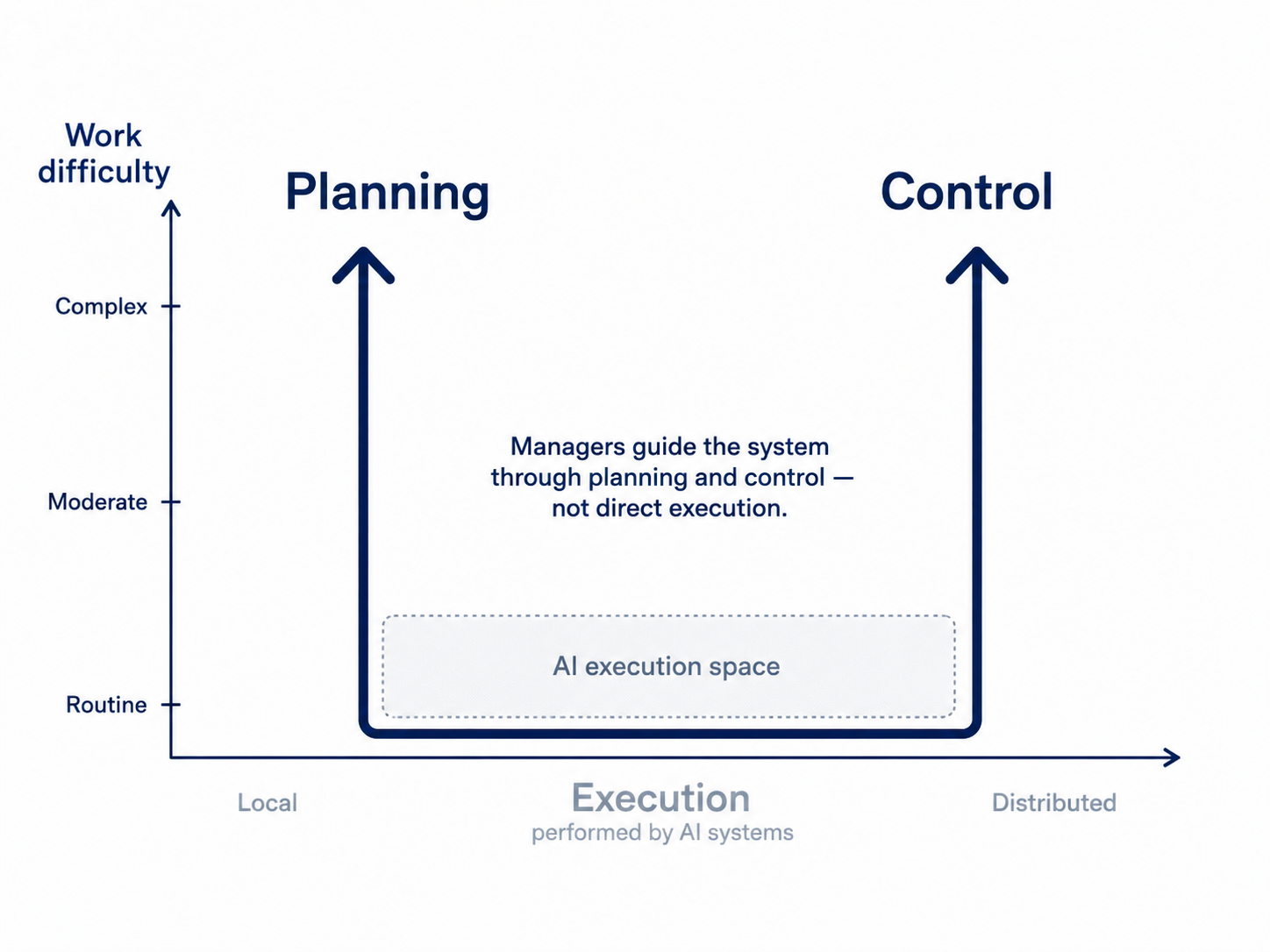
The productivity payoff
Plan and control shift
Keypoint: When AI runs execution, you can plan and steer more workstreams at once.
How ready are you to shift from doing the work to guiding AI that does it?
Answer in the live sheet:
Sources Plan and control chart
7 / 24
Same pattern — PM briefs and dev repos
Project and files
Keypoint: One bounded space per engagement — AI stays inside; swap tools, not context.
- Files or tenant spaces — AI works inside your boundary.
- Context stays put when you change model or vendor.
- PM briefs and dev repos — one engagement, one folder.
Sources Obsidian
8 / 24
Working with AI
Focus the model — narrow the wedge
LLMs go in many directions. Your job is to focus the model.
- What to ignore and what to prioritize.
- Name who reviews before it ships.
- A strong prompt becomes a skill.
9 / 24
Working with AI
Focus the model — interactive explorer
Narrow the prompt wedge — open in a new tab, then return here.
- Click levels to sharpen a vague prompt.
- Return to this deck when done.
Open the explorer:
10 / 24
Working with AI
Skills change — from prompts to chains
Keypoint: Stable workflow → save as skill → wire into a chain.
- Skill: saved instructions the model reads each run.
- Chain: skills in order with gates (plan → build → judge).
- When work changes, update the skill — keep the chain as the map.
Sources Anthropic — Building effective agents · Anthropic — Context engineering for agents
11 / 24
Working with AI
How I update this site
Keypoint: One prompt starts a chain — skills work, personas gate, then ship.
"Update the skills slide — teach us the chain while you ship it live."
- Personas review before any slide file changes.
12 / 24
Working with AI
Grill-me — lock intent before you build
Keypoint: Lock intent before you plan — one question at a time.
".grillme: Grill this slide — one question, your best guess."
- Best guess each time — you confirm or correct.
- Locks outcome, scope, and success criteria.
- Output: intake file, then
.plan.
13 / 24
Dev example — goal, loop, your approval
From prompt to goal
Keypoint: Give AI a clear goal — it loops until done while you steer and review.
/goalkeeps Codex working until the objective is met.- You pause, redirect, or approve — same pattern as PM skills.
- Good goals name success criteria, limits, and proof.
Sources OpenAI Codex — Goal mode · OpenAI Devs — Codex Thursday (May 2026)
14 / 24
Staying safe
When Fable 5 access disappeared
Recommendation: keep your data portable before a model becomes unavailable.
- Access can change overnight; your data should not.
- Back up prompts, files, and decisions outside the AI tool.
- Keep local copies so you can switch models.
Sources Anthropic statement
15 / 24
Value in practice
Consulting and GenAI — 2026 takeaways
Keypoint: the admin work shrinks; judgment and orchestration grow.
- Real now: draft, summarize, retrieve — across PM and delivery work.
- Bottleneck: workflow maturity — not model power. Hype: autonomous delivery.
Sources Deep Research — June 2026
16 / 24
Value in practice
The modern AI PM — age of agents
Keypoint: shape problems clearly — agents build; you judge what ships.
- Translation layer compresses — spec is becoming the product.
- Problem shaping, context curation, and taste — core PM skills.
- Bottleneck upstream: what’s worth building.
Sources Shubham Saboo — X article
17 / 24
Value in practice
Where AI creates value
Recommendation: find verbs you repeat — skills, loops, and your approval before anything ships.
- Any process with a repeated verb is a skill candidate.
- Loop until your test passes: “Would I send this as-is?”
18 / 24
Value in practice
Update stakeholders
Recommendation: use AI when change needs a fast, consistent update.
- Skill: turn rough notes into a stakeholder brief.
- Loop: detect change → draft update → you approve.
- Works for projects, delivery, support, and leadership.
19 / 24
Value in practice
Developer — review and triage
Recommendation: start reviews with a summary — you verify before you comment or merge.
- Skill: PR diff summary plus risk flags for reviewers.
- Skill: test failure triage from logs and stack traces.
20 / 24
Value in practice
Developer — ship with confidence
Recommendation: shipping is a verb too — draft the boring parts, you own the final wording.
- Skill: release notes from commits or changelog entries.
- Loop: collect → draft → you trim → publish.
21 / 24
Staying current
Which model is the best?
No permanent winner — pick the model for the task, not the headline.
- Leaderboards shift weekly — signals, not gospel.
- Agent boards test real workflows, not trivia.
- Stack and guardrails beat whoever is #1 today.
Sources LM Arena — Agent leaderboard
22 / 24
Staying current
My news sources
Keypoint: AI moves faster than most tech — check in once a week.
- Direction: Nate Jones · Karpathy · Ethan Mollick · Exponential View.
- Week ahead: The Rundown AI · Matt Wolfe · All AI News.
Open the full source guide in Google Docs:
Sources Full AI source guide
23 / 24
Q&A
Q&A — thank you
Thank you for completing the 7N AI Path — ask now or reach out after.
- Anonymous Q&A in the live sheet — no name needed.
- Teams chat or microphone also works.
- tm@kvalitor.dk
Download All slides as PDF
24 / 24